
Introduction
Across Australian farming operations, auger conveyors are essential for moving wheat, oats, canola, fertilizer, and animal feed.
Yet many farmers and grain handlers face the same recurring issues: accelerated auger flight wear, rising maintenance costs, and grain damage during conveying.
These problems are not caused by a single factor. They are the result of local farming conditions in Australia, crop characteristics, and how auger flighting is selected and maintained.
This article explains why auger wear and grain damage are so common in Australian agriculture and outlines practical ways to reduce these issues through better flight design and material choices.
Australian farming conditions place extra stress on auger flighting
Compared with many other agricultural regions, Australian grain handling environments are particularly demanding for mechanical equipment.
Abrasive dust and sand
In regions such as Western Australia and South Australia, grain often enters auger systems together with fine sand and dust.
This abrasive material causes rapid surface wear on screw conveyor flights, leading to:
- Faster material loss along flight edges
- Uneven wear patterns
- Sharpened edges that increase grain cracking
Long conveying distances
Many Australian farms operate over large areas. Grain augers are often used over long conveying lengths and for extended operating hours during harvest.
As conveying time increases, so does friction between the crop and the flight surface, which accelerates wear and raises the risk of grain breakage.
Hot and dry climate
High temperatures and low humidity reduce grain moisture levels.
Dry grain becomes more brittle, making it more vulnerable to cracking when exposed to pressure or worn metal surfaces.
Grain characteristics increase the risk of damage
Different grains behave very differently inside an agricultural auger system.
Wheat
Wheat is relatively hard but cracks easily at low moisture levels, especially when it contacts worn or sharp auger flight edges.
Oats
Oats are lighter and softer than wheat. They are highly sensitive to compression and uneven flight spacing, which can crush kernels during conveying.
Canola
Canola seeds are small and easily forced into gaps between the flight and casing.
Any deformation or misalignment of auger flighting can quickly lead to seed damage and product loss.
When auger flight design does not match the grain type, damage and losses increase rapidly.
| Grain Type | Ideal Handling Loss (%) | Worn Auger Loss (%) | Estimated Loss (per 1,000t) |
|---|---|---|---|
| Wheat | < 0.5% | 2.5% – 4.0% | $6,000 – $10,500 AUD |
| Canola | < 0.2% | 1.5% – 3.5% | $9,000 – $18,000 AUD |
| Oats | < 0.8% | 3.0% – 5.0% | $5,500 – $9,500 AUD |
Note: Figures are estimates based on Australian market prices and typical mechanical handling loss rates.
Common auger flight selection mistakes in agriculture
Many agricultural auger problems originate from decisions made at the selection stage.
Using flights that are too thin
Undersized flights may reduce initial cost, but they tend to deform faster under load.
As deformation increases, wear becomes uneven and sharp edges form, increasing the likelihood of grain cracking.
Choosing material based on price alone
Standard carbon steel flights can work in light-duty conditions, but in abrasive Australian environments they often wear much faster than expected.
Ignoring flight geometry and pitch
Incorrect pitch or inconsistent spacing can increase grain compression, reduce flow stability, and accelerate wear across the entire auger system.
Why auger wear and grain damage often occur together
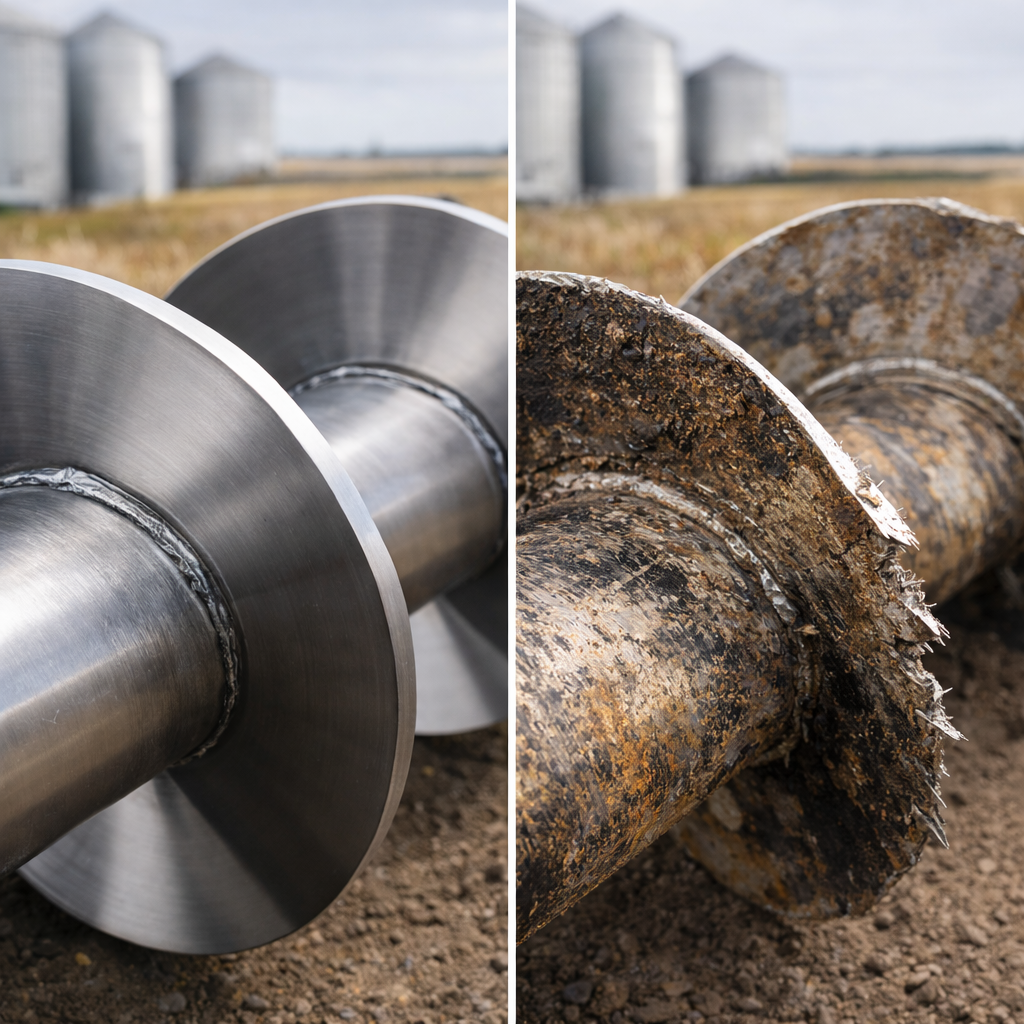
Wear and grain damage are closely linked.
As auger flighting wears down, material loss along the edges changes the original geometry. Clearances become inconsistent, and grain is exposed to greater cutting and crushing forces.
This creates a cycle:
increased wear → higher grain damage → reduced efficiency → higher maintenance costs
Breaking this cycle requires addressing both flight durability and flight design.
Practical ways to reduce auger wear and grain damage
Select materials suited to abrasive conditions
In high-abrasion farming areas, wear-resistant steels often maintain smoother surfaces for longer than standard carbon steel, helping to limit both wear and grain damage.
| Material Type | Wear Resistance | Expected Service Life | Best Suited For |
|---|---|---|---|
| Standard Steel | ★★☆☆☆ | 1 – 2 Seasons | Light duty, low-silica soils |
| Heavy Duty (Thickened) | ★★★★☆ | 3 – 5 Seasons | Standard Australian cropping |
| Hardened Alloy Steel | ★★★★★ | 6+ Seasons | High-sand areas (WA / SA) |
Use appropriate flight thickness
Thicker auger flights resist deformation and maintain consistent geometry over time, especially in long-distance conveying applications.
Consider flight design for sensitive grains
For crops such as canola and oats, more rigid and accurately formed flights can improve clearance control and reduce seed damage.
Inspect flights before peak season
Regular inspection of agricultural augers before harvest helps identify early wear, preventing unexpected downtime and grain losses during critical periods.
Real-world agricultural examples
Western Australia grain farm
A wheat operation experienced excessive grain cracking during harvest.
Inspection revealed advanced abrasion along flight edges caused by sand contamination.
After upgrading to thicker, more wear-resistant flighting, grain damage was significantly reduced the following season.
South Australia canola handling
Seed losses were traced to uneven clearances caused by deformed auger flights.
Improved flight rigidity restored stable conveying and reduced product loss.
Common mistakes to avoid
- Selecting auger flights without considering local soil and dust conditions
- Delaying replacement of worn flighting
- Using a single flight design for all grain types
- Focusing only on purchase price instead of service life
FAQ
Why do auger flights wear faster in Australia?
Because abrasive dust, dry conditions, and long operating hours increase material loss on flight surfaces.
Can auger wear really affect grain quality?
Yes. Worn and uneven flight edges are a common cause of grain cracking and seed damage.
Is thicker auger flighting always better?
Not always, but thicker flights generally maintain shape longer in agricultural use.
How often should agricultural augers be inspected?
Ideally before each harvest season and periodically during heavy use.
Conclusion
Auger flight wear and grain damage are common challenges in Australian agriculture, but they are not unavoidable.
By understanding local operating conditions, crop behavior, and auger flight design, farming operations can reduce losses and extend equipment service life.
If there is uncertainty about whether current auger flighting suits specific crops or environments, a technical review can prevent long-term problems.
Application-based guidance tailored to grain type and operating conditions often delivers the greatest value.