
Wellenlose Spiralen
Custom shaftless spiral flighting for screw conveyors and bulk material handling equipment. Manufactured to suit specific equipment dimensions, material requirements and operating conditions, subject to technical review.
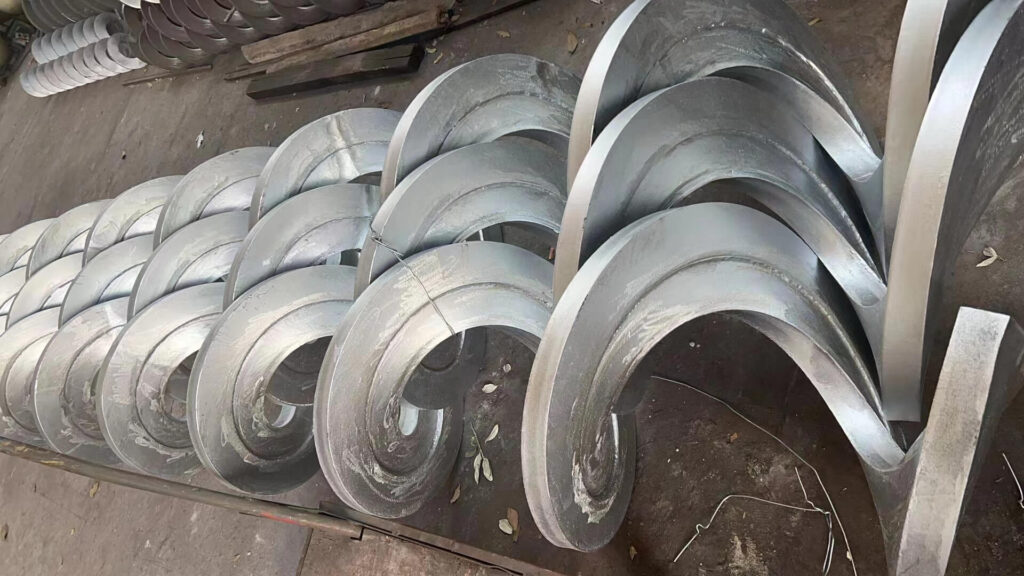
What are Shaftless Spirals?
Shaftless spirals, also known as centreless screw flights, are helical conveying components designed to operate without a continuous central shaft.
Unlike conventional shafted augers, the spiral itself transmits torque and moves material through the conveyor trough. The open-centre design can be particularly useful when handling wet, sticky, fibrous or irregular bulk materials.
Shaftless spirals are commonly used in wastewater treatment, sludge handling and industrial material conveying systems. Their dimensions, cross-section and material selection depend on the conveyor design and operating requirements.
Why Choose Shaftless Spirals?
Open-Centre Construction
No continuous centre shaft through the conveying section.
Difficult Material Handling
Suitable for consideration in sticky, wet and fibrous material applications.
Custom Geometry
Spiral dimensions can be reviewed against existing conveyor designs.
Replacement Applications
Potential replacement components for compatible shaftless conveyor systems.
FAQ
What is a shaftless spiral?
A shaftless spiral is a helical conveying component designed to operate without a continuous central shaft. Unlike conventional shafted augers, the spiral itself transmits torque and moves material through the conveyor trough.
Shaftless spirals are commonly used in screw conveyor systems for handling bulk materials, including wet, sticky and fibrous substances.
What is the difference between a shaftless spiral and a shafted auger?
A shaftless spiral operates without a continuous centre shaft, while a shafted auger uses flights attached to a central shaft or pipe.
In a shaftless system, torque is transmitted through the spiral body. In a shafted auger, the central shaft provides the main structural support and torque transmission.
The appropriate design depends on the material being conveyed, conveyor layout and operating conditions.
What materials are used for shaftless spirals?
Shaftless spirals are commonly manufactured from carbon steel, stainless steel and wear-resistant steel, depending on the application requirements.
Material selection should consider abrasion, corrosion, mechanical loading and the characteristics of the conveyed material.
Please specify your required material grade when requesting a quotation. Availability and manufacturing suitability will be confirmed during technical review.
Can shaftless spirals be manufactured to custom dimensions?
Custom shaftless spiral requirements can be reviewed according to customer drawings and existing conveyor specifications.
Important dimensions include outside diameter (OD), inside diameter (ID), pitch, spiral width, thickness and overall length.
Manufacturing feasibility depends on the requested dimensions, material, cross-section and available production capabilities.
Are shaftless spirals suitable for sludge and sticky materials?
Shaftless spirals are commonly used in conveyor systems designed to handle sludge, wet solids, sticky materials and fibrous bulk materials.
The open-centre construction eliminates the continuous central shaft, which can be beneficial in applications where material wrapping or accumulation around a shaft is a concern.
Actual suitability depends on the conveyed material, conveyor design, loading conditions and wear protection.
Can you supply replacement shaftless spirals?
Replacement shaftless spiral requirements can be assessed using technical drawings or measurements of existing conveyor components.
Please provide the spiral dimensions, material requirements, flight direction and relevant connection details.
Compatibility with the existing conveyor and manufacturing feasibility must be reviewed before a quotation is confirmed.
What information is needed for a shaftless spiral quotation?
To help us review your requirements, please provide the following information:
- Outside diameter (OD)
- Inside diameter (ID)
- Spiral pitch
- Flight width and thickness
- Overall spiral length
- Material grade or requirements
- Left-hand or right-hand rotation
- Single or multiple spiral configuration
- Required quantity
- Technical drawings, if available
Details about the conveyor equipment, conveyed material and operating conditions can also assist with technical evaluation.